
Repost | A team led by Professor Wei Huang of Oxford University, who is also Chairman of OsBio (Suzhou) Biotechnology Co., Ltd. and Chief Scientist of Oxford Suzhou Centre for Advanced Research (OSCAR), has developed programmable mini SimCells that precisely combat drug-resistant bacteria
Antimicrobial resistance (AMR) has been classified by the World Health Organization (WHO) as a global health emergency. The threat it poses is so significant that it could undo nearly a century of medical progress.
According to the WHO's estimation, in 2019, bacterial AMR directly caused 1.27 million deaths and was associated with nearly 5 million deaths. What's more alarming is that a study in The Lancet predicted that between 2025 and 2050, AMR will directly lead to more than 39 million deaths - three people will die every three minutes - and another 169 million deaths will be related to AMR. The economic losses caused by AMR are also astonishing: the World Bank estimates that by 2030, AMR may cause a global GDP loss of up to 3.4 trillion US dollars and push 24 million people into extreme poverty.
However, the pipeline for developing new antibiotics is continuously shrinking. The latest report from the WHO shows that the number of antibacterial drugs in clinical development has decreased from 97 in 2023 to 90 in 2025, and only 15 of them are considered innovative. The world urgently needs new response strategies that go beyond traditional antibiotics.
Against this backdrop, the chief scientist of our institute, Professor Huang Wei from the University of Oxford, and his team published research results in PNAS, reporting a new precise antibacterial platform based on SimCells and mini-SimCells. This platform utilizes engineered cell particles that are chromosome-free, non-replicating, biologically active, and customizable in design. It selectively identifies and eliminates target pathogenic bacteria, providing a new approach different from traditional antibiotics for dealing with multi-drug resistant bacterial infections.
What are SimCells
SimCells are engineered "simple cells" with a size ranging from 1 to 2 μm. Mini-SimCells are a smaller, nanoscale version with a particle size of approximately 100–400 nm. Since they do not carry complete chromosomes, they cannot grow and replicate, and thus have higher biological safety and controllability; at the same time, they retain the basic cellular machinery necessary to perform the preset functions.
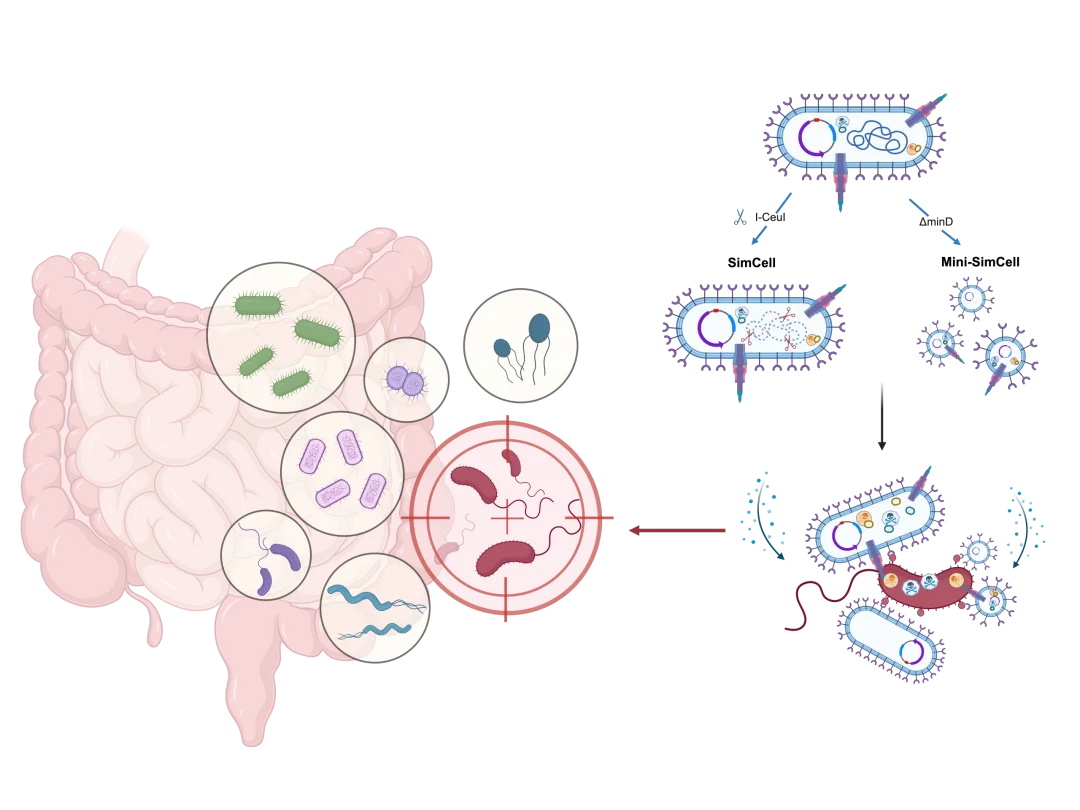
Figure 1. SimCells are programmable bacterial cells. The original genome has been completely removed and replaced by designed DNA. SimCells can be safely used in humans and animals, and are highly controllable, providing a powerful tool for precisely and selectively eliminating specific pathogens or viruses, while not disrupting other microorganisms in the microbial community.
The research team designed SimCells as programmable "biological particles", which recognize pathogens through surface expression of nanobodies, carry "nanoinjectors" and drug conversion enzymes, and can identify and attack specific bacteria like "precise missiles".
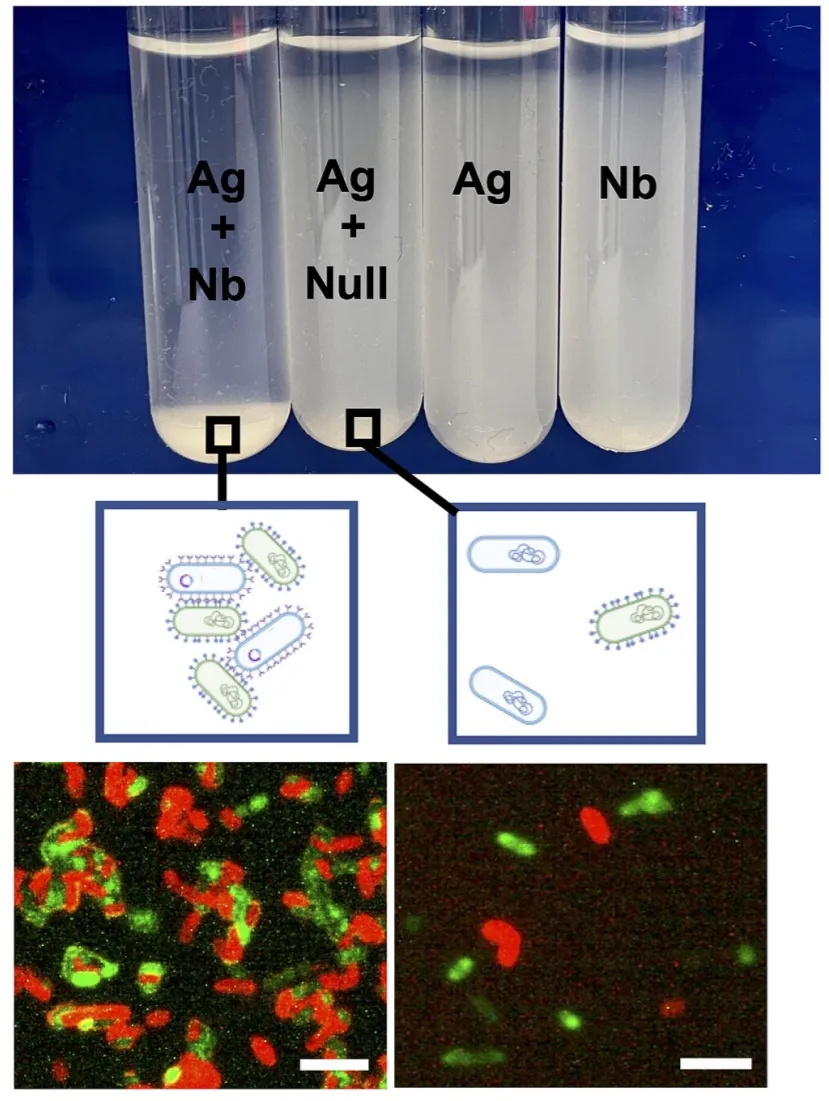
Figure 2. The fluorescence micrograph shows that the cells expressing the nanobody (in red) selectively bound and aggregated with the target cells expressing the antigen (in green).
Dual sterilization mechanism
The core innovation of this research lies in the fact that mini-SimCells possess a dual sterilization mechanism:
- Rapid killing: Once combined with the pathogen, these engineered particles utilize the type VI secretion system (T6SS) to directly inject proteins with only toxic effects on specific bacteria into the bacterial cells, equivalent to a "nanoinjector" at the molecular scale.
- Local antibacterial effect: These biological particles express the NahG enzyme, which can convert the salicylate derived from aspirin into catechol.
This process generates high concentrations of hydrogen peroxide locally and maintains persistent antibacterial activity.
The combined action of these two mechanisms enables this platform to possess both rapid killing and sustained antibacterial capabilities.
The experimental results demonstrate remarkable effectiveness
In the proof-of-concept experiment, after a single administration, the dual-mechanism mini-SimCell system was able to eliminate 94.4% of the target bacteria within 24 hours and 99.3% within 48 hours. In a mixed microbial community, through multiple administrations, the population of the target bacteria was selectively reduced by a factor of 10³ times, while the non-target bacteria were largely unaffected. This highlights the specificity and precise antibacterial advantage of this method.
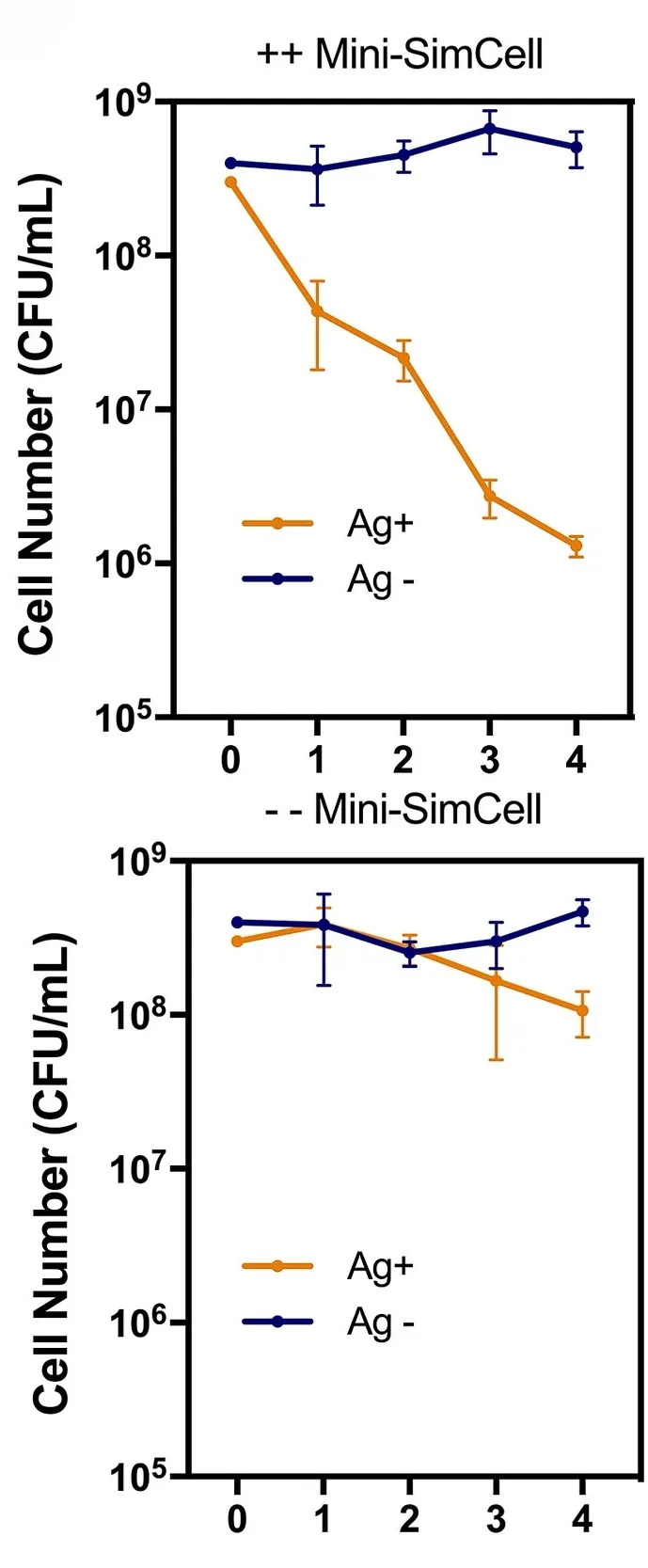
Figure 3. Through the application of four-fold doses of the dual-mechanism mini-SimCells, the target bacteria were selectively eliminated in the mixed bacterial population, with their quantity reduced by a factor of approximately 10³ times.
Effective against clinically isolated multi-drug resistant strains
The research team further applied this platform to a type of multi-drug resistant bacteria of significant clinical importance - Escherichia coli ST131. Escherichia coli ST131 is a high-risk strain that causes urinary tract infections and bloodstream infections in humans. It is widely present globally and exhibits resistance to multiple antibiotics, especially fluoroquinolones and cephalosporins.
By replacing the targeting module with a nanobody Nb39 that can recognize the natural OmpA antigen on ST131, the researchers achieved a clearance rate of over 97% for the strain within 24 hours and 48 hours. This indicates that this platform not only functions in the model system but also has the potential to carry out precise intervention for real clinical drug-resistant pathogens.
Modular design, flexible adaptation
Compared with traditional broad-spectrum antibiotics, the most significant feature of this platform is "modularity" and "plug-and-play". Its recognition module, killing module, and biological safety module can be recombined and optimized according to different pathogens, thus having the potential to quickly adapt to newly emerging drug-resistant strains.
The research team believes that in the future, this platform can also be combined with AI-assisted design of nanobodies and enzymes, further accelerating the development of new precise antibacterial treatment solutions.
This research is one of the significant achievements of the Engineering Biology department at the University of Oxford. It builds upon the SimCell technology platform developed by the team earlier, which supports early cancer treatment, functional biosensing, and virus neutralization. Now, this new research has expanded the application scope of this platform to precise treatment of drug-resistant infections.
The team from the Oxford Suzhou Centre for Advanced Research (OSCAR) played a significant role in the development of SimCell technology, demonstrating the value of international cooperation in addressing the global AMR challenge.
Related papers:
Dong Y, Ji X, Dong T, Wang Y, Bakkeren E, Foster KR, Huang WE. Reprogrammed SimCells for antimicrobial therapy. Proc Natl Acad Sci U S A. 2026 Mar 24;123(12):e2517118123. https://doi.org/10.1073/pnas.2517118123
Yin Y, Liu C, Ji X, Wang Y, Mongkolsapaya J, Screaton GR, Cui Z, Huang WE. Engineering Genome-Free Bacterial Cells for Effective SARS-COV-2 Neutralisation. Microb Biotechnol. 2025 Mar;18(3):e70109. https://doi.org/10.1111/1751-7915.70109.
Lim B, Yin Y, Ye H, Cui Z, Papachristodoulou A, Huang WE. Reprogramming Synthetic Cells for Targeted Cancer Therapy. ACS Synth Biol. 2022 Mar 18;11(3):1349-1360. https://doi.org/ 10.1021/acssynbio.1c00631.
Fan C, Davison PA, Habgood R, Zeng H, Decker CM, Gesell Salazar M, Lueangwattanapong K, Townley HE, Yang A, Thompson IP, Ye H, Cui Z, Schmidt F, Hunter CN, Huang WE. Chromosome-free bacterial cells are safe and programmable platforms for synthetic biology. Proc Natl Acad Sci U S A. 2020 Mar 24;117(12):6752-6761. https://doi.org/10.1073/pnas.1918859117.
Chen JX, Steel H, Wu YH, Wang Y, Xu J, Rampley CPN, Thompson IP, Papachristodoulou A, Huang WE. Development of Aspirin-Inducible Biosensors in Escherichia coli and SimCells. Appl Environ Microbiol. 2019 Mar 15;85(6). https://doi.org/10.1128/AEM.02959-18.
Data source:
World Health Organization (WHO): "Update on Antimicrobial Resistance", 2025. https://www.who.int/zh/news-room/fact-sheets/detail/antimicrobial-resistance
GBD 2021 Collaborators on Antimicrobial Resistance: "The Global Burden of Antimicrobial Resistance in Bacteria from 1990 to 2021 and Projections to 2050: A Systematic Analysis", The Lancet, Volume 404, Pages 1199–1226, 2024. DOI: 10.1016/S0140-6736(24)01867-1
United Nations Environment Programme (UNEP): "Preventing Superbugs: Strengthening Environmental Actions in the 'One Health' Approach to Antimicrobial Resistance Response", 2023. https://www.unep.org/zh-hans/resources/baogao/fangfanchaojixijun
World Health Organization (WHO): "WHO Releases New Report on Novel Tests and Treatments for Bacterial Infections", Press Release, October 2, 2025. https://www.who.int/mongolia/news/detail-global/02-10-2025-who-releases-new-reports-on-new-tests-and-treatments-in-development-for-bacterial-infections (Key Data: The clinical pipeline has decreased from 97 in 2023 to 90 in 2025, with only 15 of them being innovative). See also WHO: "Analysis of Clinical and Preclinical Antimicrobial Drug Research and Development in 2025: Overview and Analysis", 2025. https://www.who.int/publications/b/80370
Nicolas-Chanoine MBertrand X, Madec J: "Escherichia coli ST131: A Clone Strain Worth Noticing", Clinical Microbiology Reviews, Volume 27, 2014. DOI: 10.1128/CMR.00125-13


